Orval abbey manuscripts
The Orval abbey is located in the south of Belgium where a community of Cistercian monks is still in activity nowadays. The presence of a religious community on the site is attested since 1070. After the canons asked attachment to the Order of Cistercians, seven monks arrived at Orval on March 9th 1132.
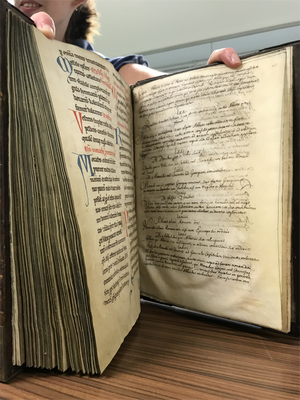
The history of the Orval scriptorium is well documented. The scriptorium was active in the 13th century mainly. A local production for parchment codices (books) and charters is attested. A complete catalog of Orval manuscripts (conserved at the Luxembourg national library) was issued in 2017. Orval charters are conserved at the State Archives in Arlon (Belgium).
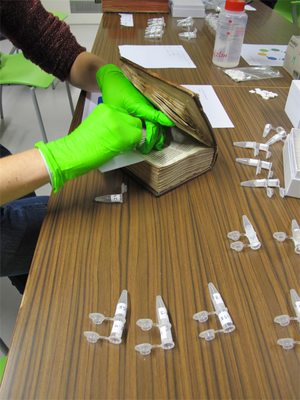
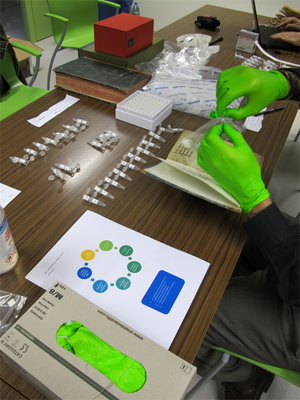
Among 74 extant re-bound manuscripts from Orval library, 68 manuscripts were made available for the study. All the 59 charters were analyzed as well. Proteomic analyses were performed on the 59 charters at MaSUN (University of Namur) and on the manuscripts (1490 samples in total) at BioArch (University of York, UK).
The results of the study are reported in details in an article published by the Royal Society UK (see Publications).