Research topics
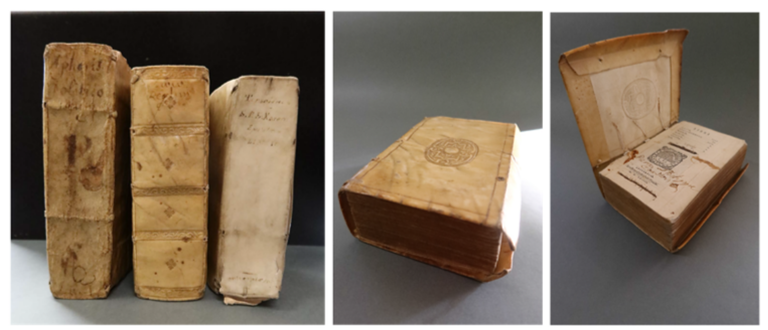
Limp bindings
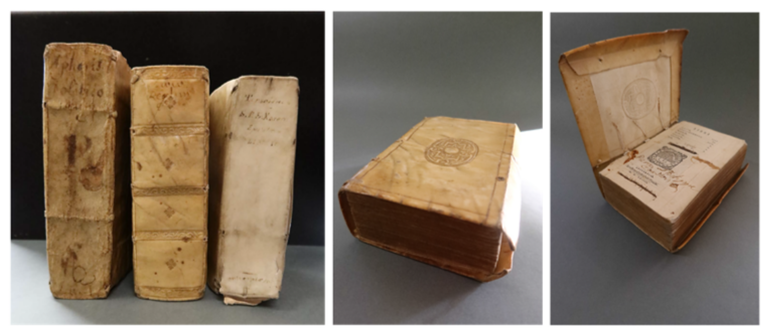
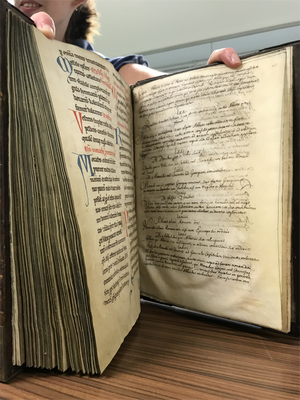
More than one hundred limp bindings (preserved at the Moretus Plantin University Library) will be analyzed. The objective is to acquire a deeper scientific knowledge about this cultural heritage by confronting data from structural analysis, bioarchaeology and imaging.
Orval abbey manuscripts
The Orval abbey is located in the south of Belgium where a community of Cistercian monks is still in activity nowadays. The presence of a religious community on the site is attested since 1070. After the canons asked attachment to the Order of Cistercians, seven monks arrived at Orval on March 9th 1132.
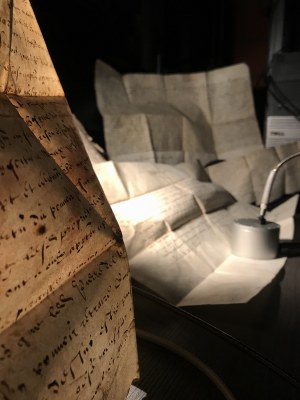
The history of the Orval scriptorium is well documented. The scriptorium was active in the 13th century mainly. A local production for parchment codices (books) and charters is attested. A complete catalog of Orval manuscripts (conserved at the Luxembourg national library) was issued in 2017. Orval charters are conserved at the State Archives in Arlon (Belgium).
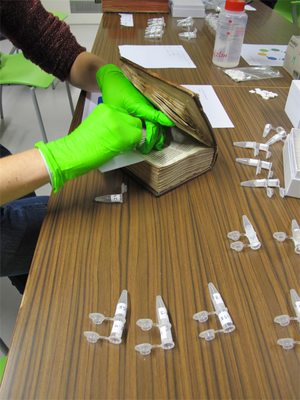
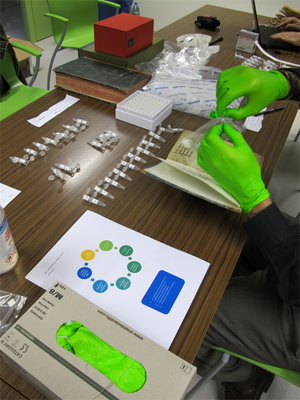
Among 74 extant re-bound manuscripts from Orval library, 68 manuscripts were made available for the study. All the 59 charters were analyzed as well. Proteomic analyses were performed on the 59 charters at MaSUN (University of Namur) and on the manuscripts (1490 samples in total) at BioArch (University of York, UK).
The results of the study are reported in details in an article published by the Royal Society UK (see Publications).
Optical methods for manuscript characterization
A non-invasive method combining optical spectrophotometry and principal component analysis was developed for the identification of parchment animal species (Alvarez et al., 2019). It was successfully validated by comparison with results of proteomic analyses performed on tens of historical parchments.
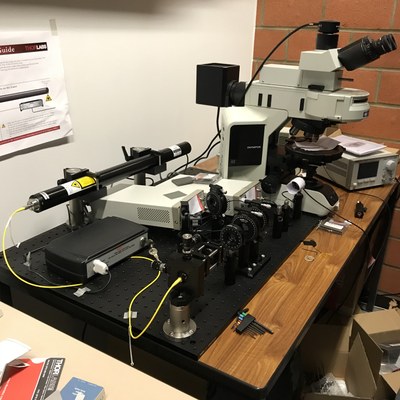
A non-invasive quantitative imaging method was developed for measuring birefringence (magnitude and axis orientation) in uniaxial optical media (Bouhy et al., 2022) and it is planned to apply it to mechanical stress as well as degradation characterization in parchments. The optical setup relies on a polarizing optical microscope combined with a laser diode and liquid-crystal devices. It operates in transmission mode.
Recreation of historical parchment manufacture
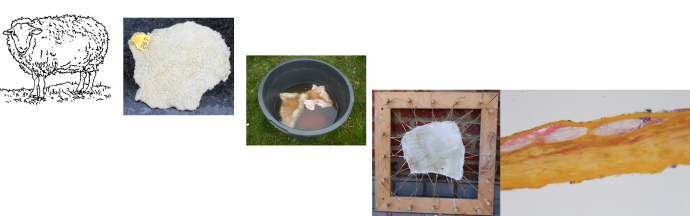
The skins from four lambs (Ovis aries) were taken from the Ovine Center of the University of Namur (natural deaths*). Parchments were fabricated by Marc Fourneau according to historical recipes and the transformation of the animal skin was studied by histological analysis at the different stages of the manufacturing process. More details can be found in the article entitled "Histological study of sheep skin transformation during the recreation of historical parchment manufacture" (see Publications).
* The animals were cared for according to procedures conforming to the European requirements on farm animals (EC directive 86/609).
PHOENIX project: Artificial Intelligence for Cultural Heritage
A consortium of 7 principal investigators from the university of Namur has received a 5-years grant (Concerted Research Actions programme) to carry interdisciplinary research in the field of cultural heritage.
The research team will be composed of a PhD student in physics, and two postdoctoral researchers, one in computing science and another in historical sciences.
The PHOENIX project (starting date: 1st October 2024) seeks to renew our understanding of medieval parchments and antique coins. Artificial intelligence will be exploited to analyse data generated by materials characterization.This joint study will address questions about the production chain and the use of these objects and materials in past societies.
Like the Phoenix which regenerates itself from age to age, we believe that the introduction of machine learning methods in heritage science will open a new age in this field.